Hammered, Milled and the legacy of Cromwell: 17th Century British silver coins
The 17th Century was a transformative period in British coinage. It was a Century marked by political upheaval, civil war, and fundamental changes in how money was produced. Silver coins, shillings, crowns, and smaller denominations saw a transition from the ancient method of hammering to the more precise technology of milling. Nowhere is this story more compelling than in the coinage of the Commonwealth (1649–1660) and the brief but remarkable issues struck in the name of Oliver Cromwell, Lord Protector of England, Scotland, and Ireland. Of particular note is the 1658 Cromwell shilling, a piece that embodies both political ambition and numismatic innovation.
Hammered vs. Milled Coinage
For Centuries, English coins had been hammered. A blank piece of silver, known as a flan or planchet, was placed between two dies, and the upper die was struck with a hammer to imprint the design. While effective, hammered coinage produced pieces of irregular shape and thickness, often leading to clipping (shaving silver off the edges) and counterfeiting.
By the early 17th Century, experiments with milled coinage produced using screw presses and machinery were underway. This method allowed for uniform round coins with milled or lettered edges, making them harder to clip. Introduced in England under Elizabeth I with the help of French engraver Eloy Mestrelle, milling did not take permanent hold until much later, but by Cromwell’s time the technology had matured.
The Commonwealth Coinage (1649–1660)
The execution of Charles I in 1649 and the abolition of the monarchy ushered in the Commonwealth of England. With the monarchy gone, coin designs required complete rethinking. Traditional royal portraits and Latin inscriptions proclaiming the divine right of kings were politically unacceptable.
Instead, the new coinage was strikingly plain and symbolic. The silver shillings, halfcrowns, and crowns featured the St. George’s cross within a shield alongside the Irish harp, representing the union of England and Ireland. Around these symbols ran the English-only legend: THE COMMONWEALTH OF ENGLAND. On the reverse, two shields were separated by a wreath, accompanied by the value expressed in Roman numerals (e.g., XII for a shilling, worth 12 pence).
These were the first English coins to bear legends entirely in English, breaking with centuries of Latin tradition. They were hammered, not milled, and while practical, they lacked artistry. The austerity of their design mirrored the stern Puritan ethos of the Commonwealth regime.
Cromwell’s Ambitious Coinage
In 1653 Oliver Cromwell assumed the role of Lord Protector, effectively becoming England’s ruler in all but name of king. By 1656–1658, new milled coinage was introduced bearing Cromwell’s portrait. These issues were executed under the direction of Thomas Simon, one of England’s greatest engravers, using advanced screw-press machinery operated by the Blondeau brothers, French specialists in coin manufacture.
Cromwell’s coins were the first milled issues to be struck in significant quantity in England. Unlike the plain Commonwealth designs, these pieces were bold and regal. Cromwell’s portrait was presented in classical style, laurel-wreathed in the manner of Roman emperors, accompanied by inscriptions in Latin, echoing the very royal traditions he had once opposed. On the reverse appeared the crowned shield of arms of England, Scotland, and Ireland, with Latin legends proclaiming PAX QVAERITVR BELLO—“Peace is sought through war.”
The 1658 Cromwell Shilling
Among these pieces, the 1658 Cromwell shilling stands out as a coin of exceptional historical and numismatic interest.
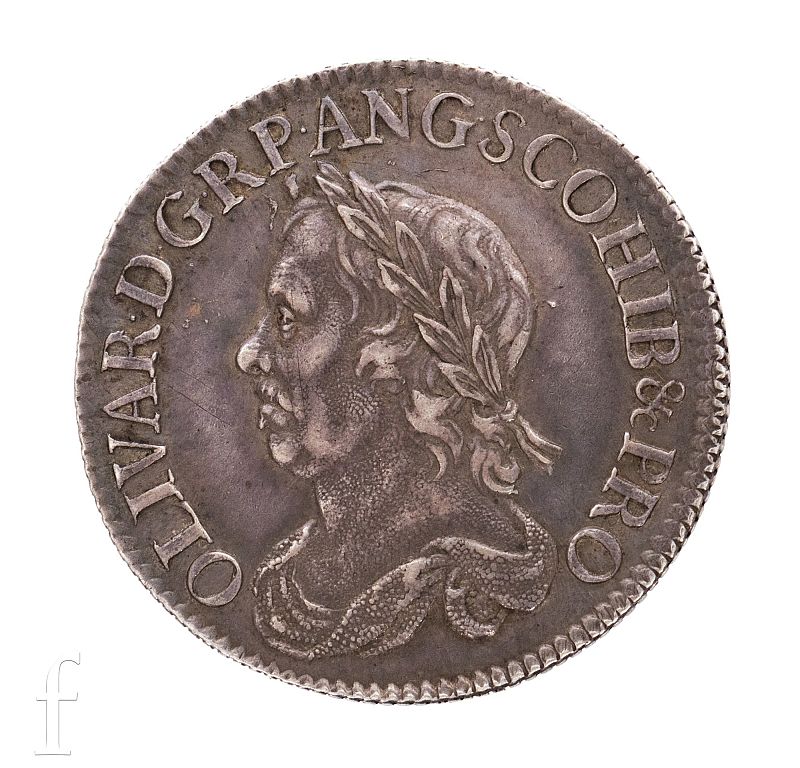
- Obverse: A right-facing bust of Oliver Cromwell, laureate, wearing armour and a draped cloak. The surrounding Latin legend reads: OLIVAR D G R P ANG SCO HIB &c PRO—“Oliver, by the Grace of God, Protector of the Republic of England, Scotland, Ireland, etc.”
- Reverse: A crowned shield of the Protectorate arms, incorporating the cross of St. George and the Irish harp, encircled by the motto PAX QVAERITVR BELLO. At the bottom appears the date, 1658.
The coin was struck in high relief, demonstrating Simon’s mastery of die engraving and the technical advantages of milling. It represented not only a leap forward in quality but also a bold political statement. Cromwell, though not a king, allowed himself to be represented as a classical sovereign, perhaps signalling ambitions of hereditary succession, ambitions cut short by his death in September 1658.
Legacy and Collectability
Cromwell’s milled issues were produced in small quantities and ceased after the Restoration of Charles II in 1660. Charles II himself fully embraced milled coinage, and from 1662 onward, all English coins were struck mechanically. Thus, Cromwell’s 1656–1658 coinage can be seen as the bridge between the hammered Commonwealth series and the modern milled coinage that became standard.
Today, the 1658 Cromwell shilling is highly prized by collectors. Its rarity, artistry, and historical importance make it one of the most sought-after coins of the 17th century. Well-preserved examples can command substantial sums at auction, especially those with sharp detail and attractive toning.
The story of 17th century British silver coinage is one of transition and turbulence. From the austere hammered shillings of the Commonwealth to the masterfully engraved milled shillings of Oliver Cromwell, the century encapsulates the intersection of politics, technology, and art. The 1658 Cromwell shilling is a coin that speaks not only of its era’s innovation but also of the ambitions of a man who sought to reshape England’s destiny. It remains a tangible reminder of a republic that was short-lived, but numismatically unforgettable.
Fieldings are delighted to offer a fine example of an Oliver Cromwell shilling in our forthcoming Specialist coins sale on Thursday 28th August
Lot 142
Oliver Cromwell (1653-1658) - A shilling 1658, laurate and draped bust left, reverse crowned coat of arms
Estimate £2,000 – 3,000
CLICK HERE TO VIEW THE 28TH SEPTEMBER SPECIALIST COIN AUCTION
Posted on 19 August 2025
Be in the know
Sign up for auction email alerts so you never miss another sale at Fieldings!
Register now